SEO
Technical SEO Audit Checklist
A practical technical SEO audit checklist for indexation, crawlability, metadata, redirects, performance, and structured data.
By Tayyiba Suleman - Published July 16, 2026 - Updated July 16, 2026 - 5 min read
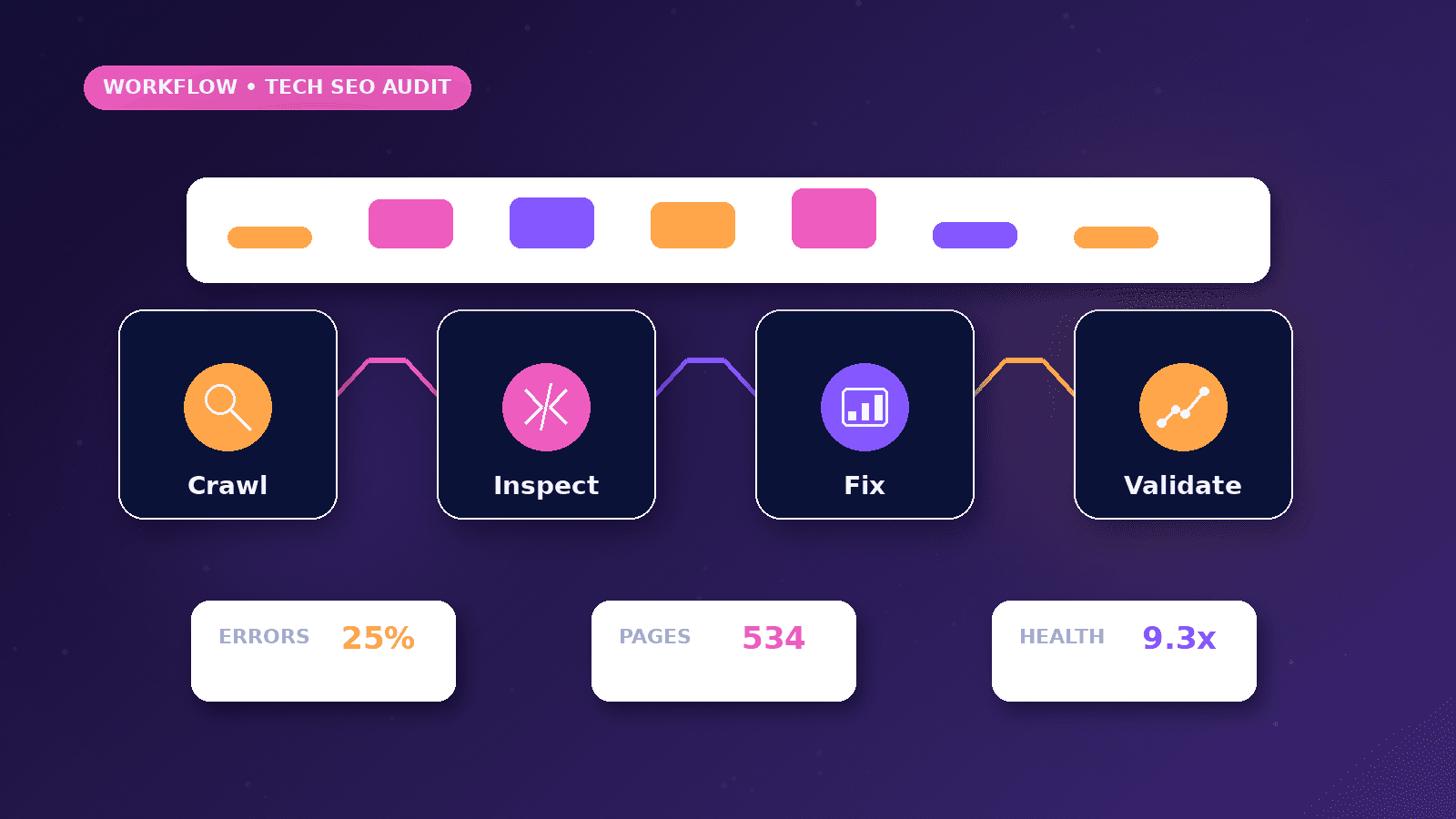
A technical SEO audit checks whether search engines can discover, crawl, understand, and index useful public pages. It also reviews mobile usability, structured data, internal linking, performance, and duplicate signals. Use this article when a website needs a practical technical SEO review covering crawling, indexation, robots, sitemap, canonicals, redirects, metadata, performance and structured data.
Reader outcome: Run a technical SEO audit. This article is educational, uses safe CurrentReach AI-owned visuals, and labels illustrative examples where they appear.
How this guide was prepared
This article is written for CurrentReach AI readers using service-planning experience, website implementation patterns, SEO checks, automation workflow review, and practical measurement considerations. It is not copied from a third-party report or generated from private account data.
Focuses on crawlability, intent, internal links, technical quality and Search Console review.
Avoids ranking guarantees and keyword-stuffing advice.
Connects visibility work with useful pages and qualified lead measurement.
Crawlability and indexation
Check that important public pages are reachable through internal links and are not blocked by robots rules.
Review sitemap URLs. They should be canonical, public, useful, and return successful status codes.
Use Search Console indexing reports and URL Inspection where owner access is available.
Robots, sitemaps and canonicals
Robots.txt should allow public content and disallow private or low-value areas such as dashboards, login pages, and internal APIs where appropriate.
A sitemap helps search engines discover important URLs, but submitting a sitemap does not guarantee indexing.
Canonical tags should point to the preferred version of a page and should not conflict with redirects or noindex decisions.
Status codes, redirects and broken links
Important pages should return 200 status codes. Redirects should be intentional and avoid chains.
Broken internal links waste crawl paths and frustrate visitors.
When content is consolidated, redirect old URLs to the closest relevant replacement rather than the homepage.
Metadata and duplicate signals
Review title tags, meta descriptions, H1s, Open Graph metadata, and canonical URLs. Each important page should have a unique purpose.
Duplicate or thin pages can confuse search engines and users. Categories, resources, and blog archives should have distinct roles.
Avoid stuffing keywords into metadata. Clarity is more valuable than repetition.
JavaScript, mobile and Core Web Vitals
Important content should be present in rendered HTML and not hidden before JavaScript runs.
Mobile layouts should avoid horizontal overflow, tiny tap targets, and overlapping text.
Core Web Vitals are not the only ranking consideration, but they are useful signals for user experience.
Structured data and internal links
Use Organization, Person, Service, BlogPosting, FAQPage, and BreadcrumbList schema only when it matches visible content.
Do not add fake ratings, reviews, awards, prices, or certifications.
Internal links should connect articles, categories, services, author pages, and policies naturally.
Worked business example
A service site loses impressions after a redesign. The audit starts by comparing live URLs, sitemap URLs, canonical tags and redirect behavior before touching keywords.
If important service pages are missing from the sitemap or canonicalized to the wrong URL, content improvements will not solve the visibility issue.
After crawl and index checks are stable, the audit moves into metadata, internal links, schema, Core Web Vitals and mobile usability.
Common mistakes to avoid
Auditing only keywords misses technical barriers that prevent search engines from discovering, understanding or trusting important pages.
Changing robots or canonical rules without testing can accidentally remove valuable pages from search consideration.
Treating every tool warning as equally important wastes time. Prioritize issues that affect public indexable pages and business-critical content.
Decision framework
Start with crawlability and indexation before metadata polish because blocked or non-canonical pages cannot perform well in search.
Separate technical SEO fixes from content strategy. A technically healthy page still needs useful, relevant content.
Use Search Console, crawl tools and browser checks together because each reveals different evidence.
Measurement plan
Track indexable URL count, sitemap coverage, redirect chains, broken links, canonical consistency, schema validation and key-page performance.
Use Search Console for indexing evidence and a crawler for site-wide patterns. Neither source alone tells the whole story.
Re-run focused checks after deployment because technical SEO fixes can be undone by routing, CMS or build changes.
Risks and limitations
Redirect chains, broken internal links and duplicate canonicals can weaken crawl efficiency and user experience.
JavaScript-rendered content can create indexing uncertainty if important content is delayed or hidden from initial HTML.
Performance work should not break forms, analytics, accessibility or conversion paths.
Practical next steps
Crawl public pages and compare them with sitemap entries.
Check robots rules, canonical tags, status codes, metadata and structured data.
Document fixes by priority and verify changes after deployment with live URLs.
Conclusion
A technical SEO audit is a sequence, not a random list of tool warnings.
Start with crawlability and indexation, then improve metadata, internal links, structured data, performance and reporting around the pages that matter most.
Practical checklist
- Crawl public pages
- Validate sitemap
- Review robots
- Check canonicals
- Check redirects
- Find broken links
- Review metadata
- Check mobile layout
- Validate schema
- Review internal links
References and further reading
Image sources
- technical-seo-audit-checklist/featured-image.png: Original CurrentReach AI blog image pack. License: Owned generated visual. No private data present.
FAQs
What should a technical SEO audit check first?
Start with robots rules, sitemap URLs, status codes, canonicals and whether key pages are indexable.
Are tool scores enough for technical SEO?
No. Tool warnings need human prioritization based on public pages, business value and real search evidence.
Can technical SEO fix thin content?
No. It can improve access and clarity, but pages still need useful, relevant content.
Need help applying this?
Need help improving crawlability, technical SEO, content structure and search visibility? Explore CurrentReach AI’s SEO Services.
Related guides
About the author
Tayyiba Suleman is Web Developer and Automation Developer. Articles are reviewed against the Editorial Policy and should be read with the Content Disclaimer.